
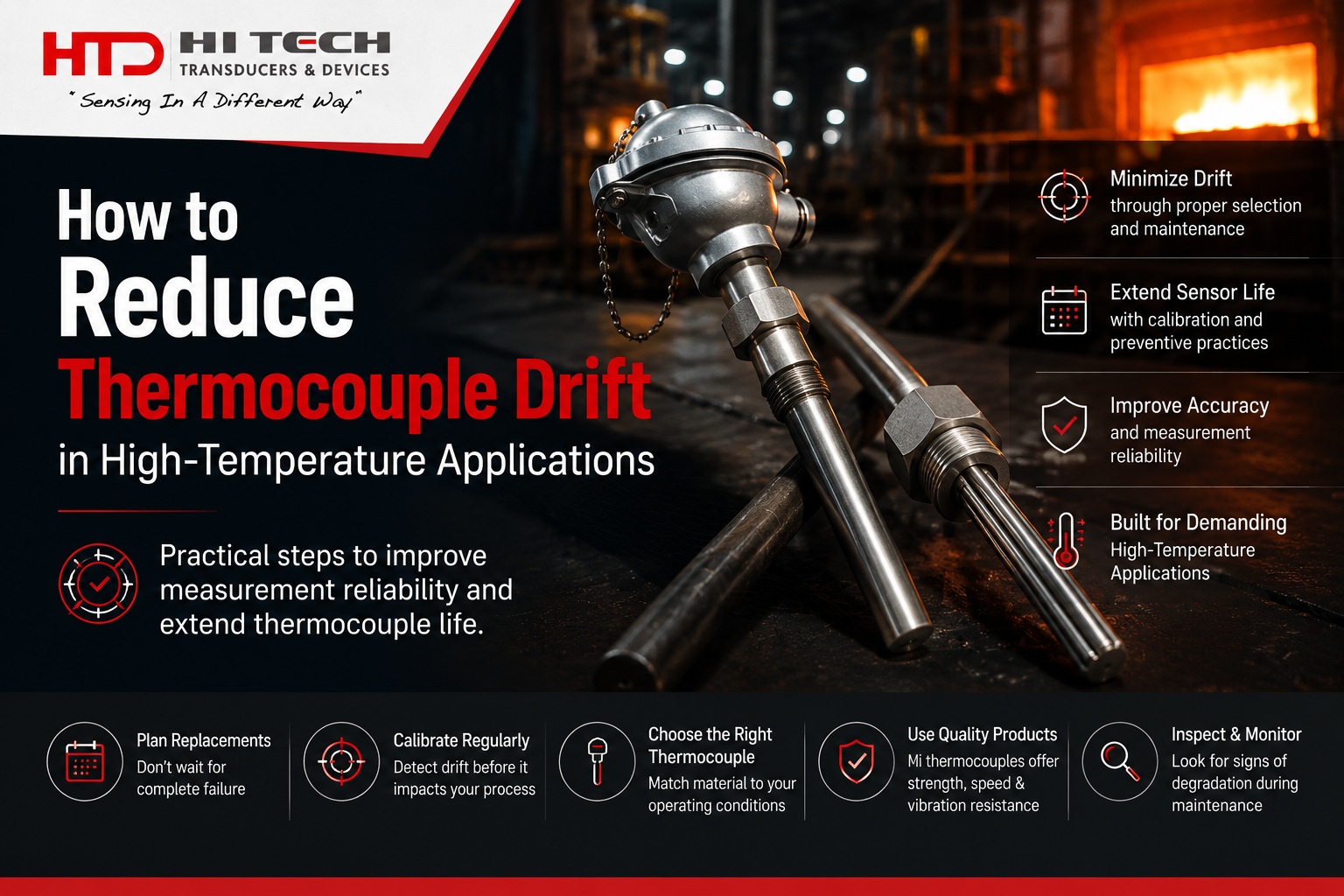
Practical steps to improve measurement reliability and extend thermocouple life
In our previous article, we discussed how thermal cycling can gradually alter thermocouple characteristics, leading to measurement drift even when the sensor continues to function normally.
While thermal cycling is often unavoidable in high-temperature processes, its impact can be significantly reduced through proper sensor selection, maintenance practices, and application-specific design.
Based on our experience in demanding industrial applications, the following practices can help improve measurement reliability and extend thermocouple service life.
1. Don’t Wait for Complete Failure
Many plants replace thermocouples only after they stop working.
However, in critical applications, a thermocouple can lose accuracy long before it fails completely.
Replace Sensors Based on Operating Hours or Months.
Define a preventive replacement interval based on process severity, operating temperature, and historical experience.
The cost of planned replacement is often insignificant compared to the cost of process instability, product rejection, or shutdowns caused by inaccurate temperature measurement.
2. Follow Periodic Calibration Practices
Regular calibration helps detect drift before it affects process performance.
- Use calibration baths or suitable reference standards for verification.
- For critical applications, follow established maintenance and calibration standards such as AMS practices.
- Even when a thermocouple is still functioning, calibration checks can reveal gradual accuracy degradation caused by thermal cycling.
3. Watch for Signs Such as Green Knotting
One field indication of degradation is the appearance of green deposits or “green knotting” on the thermocouple.
This can indicate oxidation and deterioration of the thermoelements, and it is often associated with a tendency for the thermocouple to indicate lower temperatures than the actual process temperature.
4. Use Mineral Insulated (MI) Thermocouples Where Suitable
MI thermocouples can offer advantages in demanding applications:
- Faster response time
- Better mechanical strength
- Improved protection due to the external metallic sheath
- Enhanced resistance to vibration and harsh environments
For applications with rapid temperature changes, the improved response and durability of MI designs can be beneficial.
5. Select the Correct Sheath Material and Diameter
The protection sheath plays a major role in sensor life.
- Choose sheath materials that can withstand the continuous operating temperature of the application.
- Verify the material’s maximum continuous temperature capability, not just short-term exposure limits.
- In corrosive or oxidizing environments, material compatibility is as important as temperature resistance.
6. Consider Larger Diameters When Space Permits
A larger sheath diameter can improve thermal shock resistance and mechanical durability.
- In applications with severe thermal cycling, a larger diameter may help reduce stress on the sensor and extend service life.
- However, this should be balanced against response time requirements, since larger diameters can respond more slowly to temperature changes.
Final Thoughts
Thermal cycling cannot be eliminated from most high-temperature industrial processes, but its effects can be managed.
A combination of proper sensor selection, preventive maintenance, periodic verification, and application-specific design can significantly reduce thermocouple drift and improve measurement reliability.
The goal should not simply be to keep a thermocouple operating—it should be to ensure that the temperature measurement remains accurate throughout its service life.
(- Based on over 35 years of experience in designing and manufacturing customized temperature sensing solutions for demanding industrial applications.)